Cross-posted. This article’s canonical home is Data Lakehouse Hub.
An Agentic Lakehouse is storage, catalog governance, semantic context, and agents working as one operating model. That is the useful lens for agentic lakehouse in June 2026. The market is not short on announcements. What matters is whether the new pattern changes ownership, performance, governance, and agent readiness in a way your team can operate.
The market signal behind agentic lakehouse
A chatbot over raw tables is not an Agentic Lakehouse. The architecture has to support discovery, query execution, optimization, policy enforcement, audit, and controlled action.
I care about this topic because it sits at the boundary between open data architecture and AI execution. Most companies are not choosing one engine for every workload anymore. They have warehouses, lakehouse engines, streaming systems, catalogs, metadata platforms, and now agents that ask for data through tools. The shared contract between those systems matters more than any single feature checkbox.
The vendor-neutral reading is straightforward. If the underlying table and catalog standards get stronger, buyers get more freedom to choose the right engine for each job. Snowflake, Microsoft, ClickHouse, Atlan, Dremio, and the open-source Iceberg ecosystem all point to the same market reality: data platforms are becoming multi-engine and agent-facing.
How the architecture works
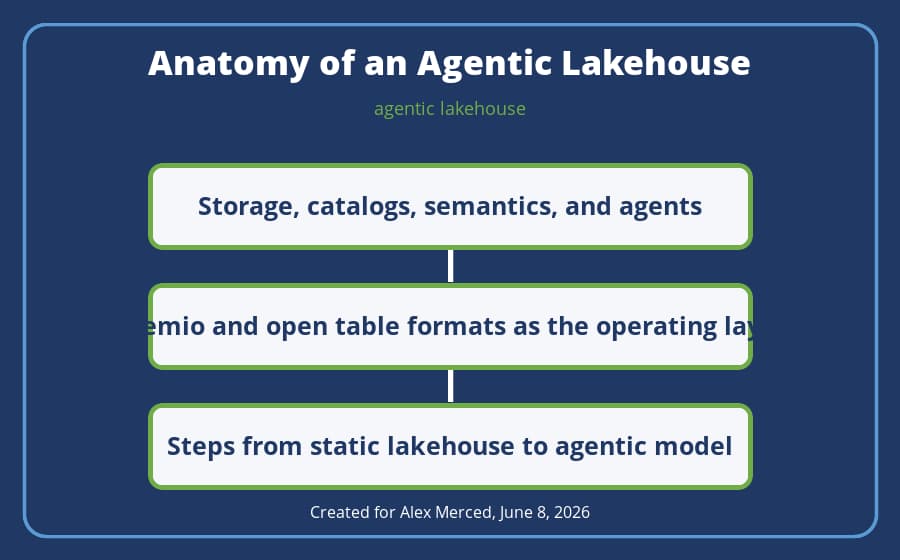
The storage layer should use open table formats such as Apache Iceberg.
The catalog layer should manage table identity, commits, access, and metadata.
The semantic and agent layers should expose business-approved objects and safe tools.
The important architectural habit is to separate responsibilities. The table format manages files, snapshots, schema evolution, and table metadata. The catalog manages identity, namespaces, commits, and access patterns. The query engine plans and executes work. The semantic layer maps raw data into business meaning. The agent interface decides which safe tools a model can call.
That separation keeps the system honest. If a vendor says a workload is open, ask which layer is open. If a feature supports Iceberg, ask which Iceberg version, which operations, and which engines. If an agent can query data, ask whether it is querying raw tables or certified semantic views.
A concrete operating example
A sales agent that investigates pipeline risk should not scan random warehouse tables. It should query certified opportunity views, respect territory permissions, use approved definitions, and write any follow-up action to an auditable system.
That example is intentionally operational. Architecture diagrams are useful, but the design only proves itself when a real workload runs through it. I want to know who owns the table, which catalog authorizes the operation, which engine writes, which engine reads, which semantic view users see, and how the team detects a bad result.
For agentic analytics, the same example gets stricter. A human analyst can notice ambiguity and ask a teammate. An agent will often keep going unless the tool interface stops it. That means your architecture needs approved definitions, scoped access, query limits, logging, and a clean rollback path before it needs a flashy chat experience.
This is why I do not treat open table formats as the whole story. Apache Iceberg gives the platform a strong storage contract. It does not, by itself, define customer lifetime value, revenue recognition rules, data owner approval, or what an AI agent may do after it finds an anomaly. Those rules belong in catalogs, semantic layers, governance systems, and agent tools.
What this means for the lakehouse
A lakehouse platform needs five capabilities to serve agents reliably: query federation to reduce data movement; autonomous performance using Reflections, caching, and table optimization so interactive loops stay fast; an AI Semantic Layer that gives agents approved business context; agentic interfaces through the UI, Python, or MCP-connected tools; and AI SQL functions that bring model-assisted work into SQL without exporting data.
Implementation checklist
| Decision | What to document | Why it matters |
|---|---|---|
| Table contract | Format version, schema rules, snapshot policy, and rollback plan | Engines need the same understanding of the table. |
| Catalog authority | Production catalog, namespaces, commit rules, and role model | Multi-engine systems need one source of table truth. |
| Engine matrix | Read, write, merge, delete, schema, and view support by engine | A feature is not production-ready until the exact operation is tested. |
| Semantic layer | Certified views, metric definitions, owners, and labels | Agents need business meaning, not raw schemas alone. |
| Security | Credential model, token lifetime, row filters, column masks, and audit logs | Open access still needs strict governance. |
| Operations | Compaction, vacuum, retries, alerting, and incident ownership | The design must survive failed jobs and bad deploys. |
My practical checklist for this topic is:
- Start with certified semantic views over the most important datasets.
- Add agent tools only after policy and audit are in place.
- Use Reflections and table optimization to keep exploratory loops fast.
- Expand from read-only investigation to controlled action only after validation.
If those items are not written down, the project is still in the demo stage. That does not mean the idea is weak. It means the operating model is not finished.
Failure modes worth respecting
Autonomy without policy just creates faster mistakes. The architecture must make the allowed path easier than the unsafe path.
The other failure mode is semantic drift. A table can be technically valid while the business definition on top of it changes quietly. That is where many AI analytics projects fail. The model generates SQL against a table that exists, the query returns rows, and the answer looks plausible. The problem is that the answer used the wrong grain, the wrong filter, or the wrong metric definition.
The fix is not a longer prompt. The fix is stronger data contracts. Certified semantic views should be easier for agents to use than raw tables. Sensitive columns should be masked or hidden before the model can ask for them. Write-capable tools should require intent, validation, and idempotency. Expensive queries should have limits. Every tool call should leave evidence.
This is also where vendor-neutral thinking helps. Do not trust a platform because it has the best demo. Trust the platform when it gives you clear contracts between storage, catalog, semantic layer, engine, and agent. Trust it more when you can test those contracts with another engine or another client.
What I would do first
Start with one production-shaped workflow. Do not start with the easiest toy table, and do not start with the most politically sensitive workload. Pick a table or semantic view that matters, has an owner, has known correctness checks, and can tolerate a controlled pilot.
For agentic lakehouse, I would write down five things before touching production: the owner, the accepted engines, the policy boundary, the rollback path, and the agent-facing interface. Then I would run the same workflow three ways: manually, through the intended query engine, and through the agent or automation layer. Differences between those paths are where the real work begins.
Measure boring things. Count files. Count snapshots. Track query planning time. Track storage calls. Track failed commits. Track token issuance. Track denied access. Track whether a human can explain the result without reading tool logs for an hour. These metrics are not glamorous, but they tell you whether the architecture is ready.
Final recommendation
The right conclusion is not that every team should adopt every June 2026 feature immediately. The right conclusion is that the lakehouse is becoming an execution surface for humans and agents, and that changes the quality bar. Open storage is necessary. Governed catalogs are necessary. Semantic context is necessary. Fast SQL is necessary. Scoped agent tools are necessary.
That combination is exactly why the Agentic Lakehouse is becoming the right framing. It describes the platform you need when AI agents stop answering isolated questions and start participating in analytical workflows.
For more background on the lakehouse and AI side of this work, explore my books on data lakehouses and AI at books.alexmerced.com. If you want to try this style of governed, open, agent-ready architecture in practice, start a free trial of Dremio’s Agentic Lakehouse at dremio.com/get-started.
Field notes for teams evaluating this now
First, make compatibility visible. A table-format version, catalog endpoint, and engine release should appear in your runbook. If a production issue happens, nobody should have to guess which engine wrote the latest snapshot or which client introduced a metadata change.
Second, keep the semantic layer close to the workflow. If the article topic affects analytics agents, customer-facing metrics, financial reporting, or regulated data, raw-table access should be the exception. Certified views should be the normal path.
Third, separate experimentation from certification. Engineers need sandboxes where they can test new Iceberg features, catalog options, and agent tools. Business users and agents need certified surfaces where definitions, owners, and policies have already been reviewed.
Fourth, keep the architecture open. Not every byte must move into one platform. An architecture that can query data in place, add semantic context, accelerate common workloads, and expose governed agent interfaces over open data creates more flexibility.
Fifth, publish the limits. If a feature is read-only in one engine, say so. If write interoperability is approved only for append workloads, say so. If remote signing is required for regulated tables, say so. Clear limits create trust. Hidden limits create incidents.
Identity and access review
For agentic lakehouse, I would run one full dry run with production-like identities. Use an analyst identity, a service account, and the intended agent identity. Confirm that each identity sees only the expected semantic objects, receives predictable errors, and leaves useful audit records. That test catches policy gaps before they become production incidents.
The agent identity matters most because it is easy to over-permission during a pilot. If the agent only needs a certified revenue view, do not give it namespace-wide table discovery. If the agent needs row-level access for one geography, test that a second geography returns a denial instead of silent leakage.
Documentation that actually helps
The documentation should fit on one page. Name the owner, the supported engines, the catalog authority, the accepted table operations, the security model, and the rollback path. If a new engineer cannot understand the contract for agentic lakehouse from that page, the architecture is still too implicit.
Good documentation is not a wiki dump. It is an operating contract. It should say who can approve a schema change, which engine owns compaction, how long snapshots are retained, and what happens when an agent produces a suspicious result. That level of detail is what turns a promising pattern into a maintainable system.
How to keep agents in bounds
Agents should not receive broad table access just because a human can ask broad questions. For agentic lakehouse, expose narrow tools over certified views first. Add write-capable tools only after you have validation rules, idempotency keys, approval gates, and audit records that a reviewer can follow.
The tool description should also be honest. If a tool returns estimated data, say estimated. If a tool excludes delayed transactions, say that. If a tool is read-only, make that clear in the name and policy. Agents work better when the interface gives them fewer chances to infer the wrong contract.
What to measure after launch
The first production month should be measurement-heavy. Track planning time, query latency, failed commits, denied access attempts, credential issuance, snapshot growth, and semantic-view usage. If agentic lakehouse is helping, the evidence should show up in fewer manual workarounds and clearer operational ownership.
I would also track human trust signals. Are analysts using the certified view more often? Are engineers filing fewer tickets about unclear table ownership? Are agents producing answers that reviewers can trace back to approved definitions? Those signals tell you whether the architecture is improving daily work, not just passing a benchmark.
A buyer question worth asking
The buyer question is simple: does this pattern increase choice without weakening governance? For agentic lakehouse, the best answer is specific. It should name the table format, catalog contract, semantic surface, security controls, and engine support matrix. Anything less is a demo, not an operating model.
This is where the architecture should stay disciplined. The point is not that open architecture is automatically better. The point is that open architecture gives you room to test engines, keep data in place, add semantic context, and still maintain control. That is a stronger argument than a generic platform claim.
A realistic rollout sequence
The rollout should start with read visibility, then move to operational automation, then consider action loops. For agentic lakehouse, the first milestone is a certified read path with approved semantics. The second milestone is repeatable validation through CI or scheduled checks. The third milestone is agent access with narrow tools and strict audit.
Write paths should come later unless the topic itself is about write interoperability or table maintenance. Even then, begin with append-only or isolated writes. Updates, deletes, merges, and external actions need stronger controls because they change the state other people depend on.
How this should sound to executives
The executive version should avoid implementation trivia, but it should not become vague. Say that agentic lakehouse helps the company keep analytical data open, governed, and ready for AI-assisted work. Then say what the team will measure: cost, speed, correctness, access control, and operational effort.
That framing is useful because executives do not need every catalog detail. They do need to know whether the architecture reduces lock-in, improves reliability, and gives agents a trustworthy data foundation. Those are business outcomes tied to technical choices.
How this should sound to engineers
The engineering version should be blunt. Which APIs are used? Which engine versions are approved? Which table operations are allowed? Which failures are retried? Which failures stop the workflow? Which logs prove that the right identity performed the right operation?
For agentic lakehouse, those questions are more valuable than broad claims. They force the team to define the boundary between the open standard, the vendor implementation, the query engine, the semantic model, and the agent tool.
What not to automate yet
Do not automate the parts of agentic lakehouse that the team cannot explain manually. If nobody can explain the metric, the agent should not calculate it. If nobody can explain rollback, the agent should not write. If nobody can explain the security boundary, the tool should stay internal.
This is not anti-automation. It is how automation earns trust. Automate the parts with clear contracts first, then widen the scope as evidence accumulates.
Source-of-truth ownership
Every production rollout needs one named source of truth for each layer. The table has an owner. The catalog has an owner. The semantic view has an owner. The agent tool has an owner. For agentic lakehouse, those owners may sit on different teams, but the contract between them has to be explicit.
Clear ownership across all layers keeps the architecture credible, whether the governed execution and semantic layer lives in one platform or across several independent services.
Clear ownership prevents avoidable production confusion.
Review cadence
Set a review cadence before the first production launch. For agentic lakehouse, I would review the contract after the first week, after the first month, and after the first engine or catalog upgrade. Most problems appear when a workflow that worked in a pilot meets a new version, a new identity, or a new business definition.
That review should include both platform engineers and business owners. Engineers can verify the mechanics. Business owners can verify that the answers still mean what the company thinks they mean.
Launch criteria
The launch criteria should be binary. Either agentic lakehouse has a named owner, passing validation checks, approved security boundaries, working rollback, and documented engine support, or it is not ready. Gray areas are acceptable in a research project. They are expensive in production.
This keeps the article’s recommendation practical: prove the contract first, then widen adoption.
Compliance evidence
Save the evidence. For agentic lakehouse, keep validation output, approval records, denied-access tests, and rollback proof with the release notes. Future audits are easier when the team can show what it tested before launch.
Test cases that matter
Use test cases that reflect real business questions. For agentic lakehouse, include at least one happy path, one denied-access path, one stale-data path, and one rollback path. Those tests reveal more than a generic demo query.